
Preceptors
The philosophers, charters, and pamphlets that shaped the Declaration of Independence — and the government its principles produced
Aristotle (384–322 BC)
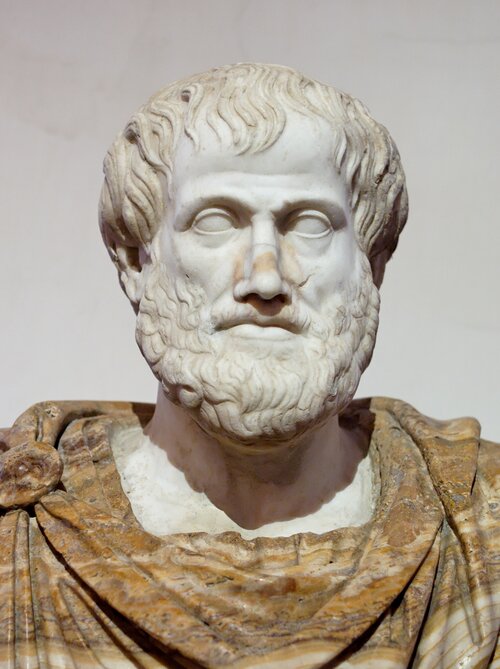
AristotleAristotle (384–322 BC) was an ancient Greek philosopher and polymath. His writings span the natural sciences, philosophy, linguistics, economics, politics, psychology, and the arts. As the founder of the Peripatetic school of philosophy in the Lyceum in Athens, he began the wider Aristotelian tradition that followed, which set the groundwork for the development of modern science. Read more on Wikipedia ↗ (CC BY-SA) does not appear in the Declaration by name, but the document's assumptions are downstream of his. In the Politics, Aristotle argued that the purpose of a political community is not merely survival but the good life — that government exists to serve human flourishing, and can be judged and found wanting against that standard. He also distinguished just constitutions, which rule in the common interest, from unjust ones, which rule in the ruler's private interest — a distinction that anticipates the Declaration's charge that George IIIGeorge III was King of Great Britain and Ireland from 1760 until the union of the two countries in 1801, after which he was King of the United Kingdom of Great Britain and Ireland until his death in 1820. He was concurrently Duke and Prince-elector of Brunswick-Lüneburg (Hanover) in the Holy Roman Empire. Read more on Wikipedia ↗ (CC BY-SA)'s government had become a "tyranny" ruling for itself rather than for the governed. Aristotle's broader legacy to the American founders came less through direct citation than through the natural lawNatural law is a philosophical and legal theory that posits the existence of inherent laws derived from nature and universal moral principles that are discoverable through reason. In ethics, natural law theory asserts that certain rights and moral values are inherent in human nature and can be universally understood, independent of enacted laws or societal norms. Read more on Wikipedia ↗ (CC BY-SA) tradition his students and successors built on his work: the idea that reason can discover a moral order built into human nature itself, and that positive law is answerable to it. That is the philosophical scaffolding underneath Jefferson's appeal to "the Laws of Nature and of Nature's God."
Cicero (106–43 BC)
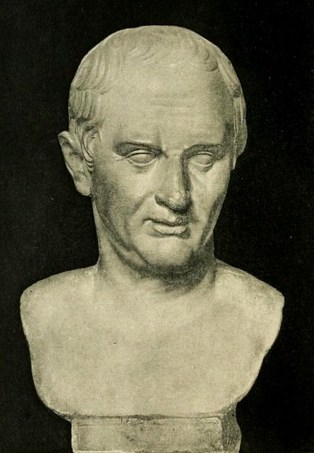
Late in life, accused of having copied the Declaration rather than invented it, Jefferson did not deny the charge — he owned it. Writing to Henry Lee in 1825, he explained that the Declaration was never meant to say anything new: its purpose was to be "an expression of the American mind," and its authority rested on "the harmonizing sentiments of the day, whether expressed in conversation, in letters, printed essays, or in the elementary books of public right, as Aristotle, Cicero, Locke, Sidney, etc." CiceroMarcus Tullius Cicero (3 January 106 BC – 7 December 43 BC) was a Roman statesman, lawyer, scholar, philosopher, and academic skeptic who played an important role in the politics of the late Roman Republic and wrote a large number of treatises on rhetoric, philosophy, and politics. Read more on Wikipedia ↗ (CC BY-SA) supplied the Roman answer to the question Aristotle had opened: what makes a law legitimate. In De Re Publica, he wrote that "true law is right reason in agreement with nature, it is of universal application, unchanging and everlasting," and that "we cannot be freed from its obligations by senate or people." A law above human law, discoverable by reason rather than granted by any crown, binding rulers and ruled together — that formula is the direct ancestor of Jefferson's appeal to "the Laws of Nature and of Nature's God" in the Declaration's opening sentence. Cicero's own political career ended in a version of the same argument put into practice: after Julius CaesarGaius Julius Caesar was a Roman general and statesman. A member of the First Triumvirate, Caesar led the Roman armies in the Gallic Wars before defeating his political rival Pompey in a civil war, and became Roman dictator from 49 BC until his assassination in 44 BC. Read more on Wikipedia ↗ (CC BY-SA)'s assassination, he used his final speeches, the Philippics, to attack Mark AntonyMarcus Antonius, commonly known in English as Mark Antony, was a Roman politician and general who played a critical role in the transformation of the Roman Republic into the Roman Empire. Read more on Wikipedia ↗ (CC BY-SA)'s bid to inherit Caesar's one-man rule and to argue for restoring the Republic's institutions. Antony had him proscribed and killed for it in 43 BC. The colonists inherited from Cicero not just a theory of law above kings, but the example of someone who paid with his life for saying so.
Magna Carta (1215)
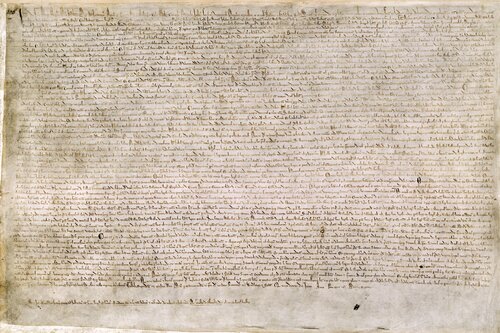
In June 1215, a group of rebellious English barons forced King John to seal Magna CartaMagna Carta (Medieval Latin for "Great Charter") is a royal charter of rights sealed by King John of England at Runnymede, near Windsor, on 15 June 1215. First drafted by the Archbishop of Canterbury, Cardinal Stephen Langton, to make peace between the unpopular king and a group of rebel barons who demanded that the King confirm the Charter of Liberties, it promised the protection of church rights, protection for the barons from illegal imprisonment, access to swift and impartial justice, and limitations on feudal payments to the Crown. Read more on Wikipedia ↗ (CC BY-SA) at Runnymede. Most of its 63 clauses addressed narrow feudal grievances that mean little today, but a handful established a principle with an extraordinarily long reach: that the king himself was subject to the law, not its source. Clause 39 promised that no free man would be imprisoned, dispossessed, or destroyed "except by the lawful judgment of his equals or by the law of the land" — the ancestor of the phrase "due process of law" that eventually reached the Fifth and Fourteenth Amendments. Magna Carta also established a template the Declaration itself follows: a formal, written document that lists specific royal abuses one by one and demands their correction as a condition of continued obedience. By 1776, colonial lawyers — nearly all trained in a legal tradition steeped in Magna Carta — treated it as proof that even a king ruled under law, and that a king who broke that compact broke faith with his own subjects.
Read the full 1215 text at the Avalon Project, Yale Law School ↗.
John Locke (1632–1704)
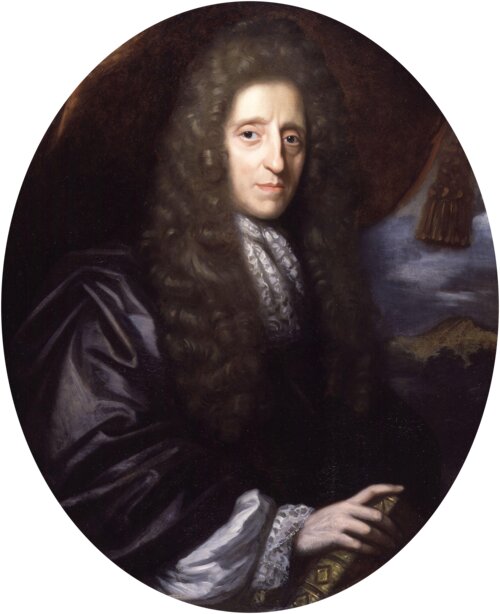
No single thinker's fingerprints are more visible on the Declaration than John LockeJohn Locke (29 August 1632 – 28 October 1704) was an English philosopher and physician, widely regarded as one of the most influential of the Enlightenment thinkers and commonly known as the "father of liberalism". His important works include A Letter Concerning Toleration (1689), Two Treatises of Government (1689/90), and An Essay Concerning Human Understanding (1689/90). Read more on Wikipedia ↗ (CC BY-SA)'s. In his Second Treatise of Government (1689), Locke argued that human beings possess natural rights — he named life, liberty, and property — that exist prior to and independent of government, and that people form governments through a social contractIn moral and political philosophy, the social contract is an idea, theory, or model that usually, although not always, concerns the legitimacy of the authority of the state over the individual. Social contract arguments typically are that individuals have consented, either explicitly or tacitly, to surrender some of their freedoms and submit to the authority of the ruler, or to the decision of a majority, in exchange for protection of their remaining rights. Read more on Wikipedia ↗ (CC BY-SA) for the specific purpose of protecting those rights. Government, on this view, is not a gift from a king to his subjects but an instrument the people create and can revoke. When a government becomes destructive of the rights it was created to protect, Locke argued, the people have both the right and the responsibility to alter or abolish it. Jefferson's language in the Declaration's second paragraph — that governments derive "their just powers from the consent of the governed," and that "whenever any Form of Government becomes destructive of these ends, it is the Right of the People to alter or to abolish it" — restates Locke's argument closely enough that historians have long treated the Second Treatise as its direct source, even though Jefferson substituted "the pursuit of Happiness" for Locke's "property" in the famous triad. See Jefferson's rough draft for how that phrase reached its final form.
Algernon Sidney (1623–1683)
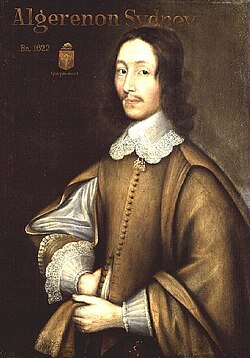
The same 1825 letter to Henry Lee that named Cicero also named Algernon SidneyAlgernon Sidney or Sydney (15 January 1623 – 7 December 1683) was an English politician, republican political theorist and colonel. Read more on Wikipedia ↗ (CC BY-SA), and Jefferson meant it: he later recommended Sidney's Discourses Concerning Government to the University of Virginia's law students as one of two essential texts, alongside Locke, on "the general principles of liberty and the rights of man in nature and in society." Written in the early 1680s as a point-by-point rebuttal of the theory that kings rule by divine, patriarchal right, the Discourses argued at length that the natural liberty and equality of mankind is a truth "evident to common sense" — the same claim Jefferson would compress a century later into "we hold these truths to be self-evident." Sidney never saw the book published: the manuscript was used as evidence against him at his 1683 treason trial, on the theory that merely writing that a tyrant could be resisted was itself an act of treason, and he was executed on that basis. The Discourses appeared in print only in 1698, fifteen years after his death. To eighteenth-century readers on both sides of the Atlantic, Sidney's execution made him a martyr as much as an author — proof, in the colonists' eyes, that the principles his book defended were exactly the ones a crown most feared.
The English Bill of Rights (1689)
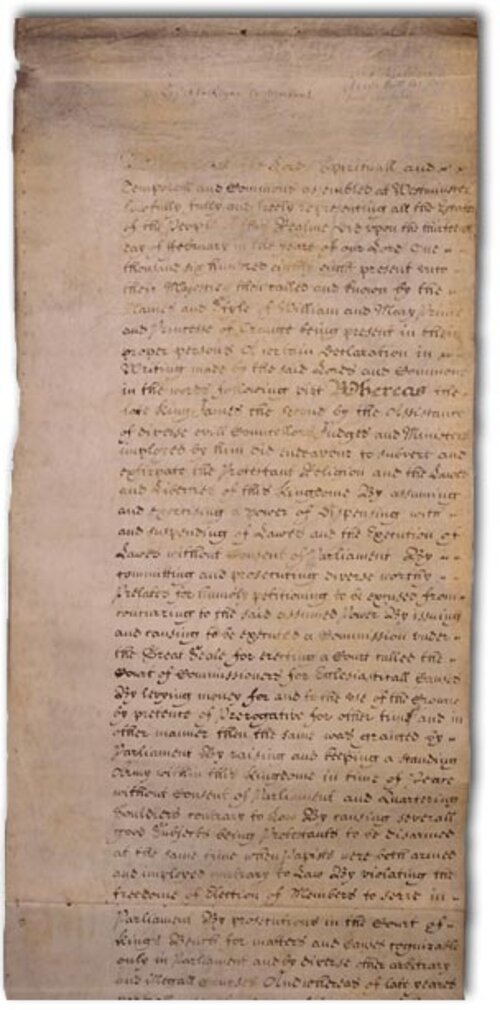
The Glorious RevolutionThe Glorious Revolution was the deposition of King James II in November 1688. He was replaced by his daughter Mary II and her Dutch husband, James's nephew William III of Orange. The two ruled as joint monarchs of England, Scotland, and Ireland. Read more on Wikipedia ↗ (CC BY-SA) of 1688 deposed King James II and installed William and Mary in his place. Parliament justified the change with the Bill of Rights 1689The Bill of Rights 1689 is an act of the Parliament of England that set out certain basic civil rights and changed the succession to the English Crown. Largely based on the ideas of political theorist John Locke, the Bill sets out a constitutional requirement for the Crown to seek the consent of the people as represented in Parliament, and sets limits on the powers of the monarch. Read more on Wikipedia ↗ (CC BY-SA), a document whose structure the Declaration echoes closely: a preamble asserting the people's rights, followed by an itemized list of the ways the previous king had violated them — levying money without Parliament's consent, maintaining a standing army in peacetime without Parliament's consent, and interfering with the courts among them — offered as the specific justification for withdrawing allegiance. Eighty-seven years later, Jefferson's list of twenty-seven grievances against George III, introduced with "The history of the present King of Great Britain is a history of repeated injuries and usurpations," follows the same form: rights first, facts second, conclusion last. The 1689 Bill of Rights also established, in England, the very principle the colonists insisted their king had abandoned in America — that a monarch governs by consent of the governed as represented in a legislature, not by prerogative alone.
Read the full text at legislation.gov.uk ↗, the UK government's official statute archive.
Montesquieu (1689–1755)
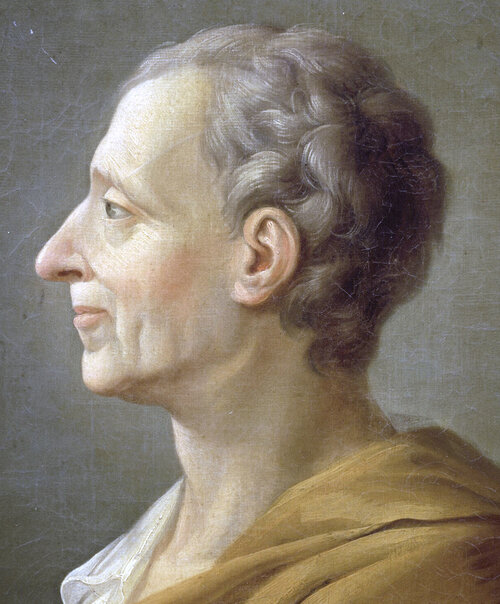
MontesquieuCharles Louis de Secondat, baron de La Brède et de Montesquieu (18 January 1689 – 10 February 1755), generally referred to as simply Montesquieu, was a French judge, intellectual, historian, and political philosopher. He is the principal source of the theory of separation of powers, which is implemented in many constitutions throughout the world. Read more on Wikipedia ↗ (CC BY-SA) belongs on this list less for the Declaration itself than for the government the Declaration made possible. His 1748 treatise The Spirit of the Laws argued that liberty is best secured not by virtuous rulers but by structure: by dividing legislative, executive, and judicial power among separate bodies so that "power checks power," none of them able to accumulate enough to become tyrannical. The Declaration's grievances against George III repeatedly accuse him of collapsing exactly those distinctions — making judges dependent on his will alone, combining with others to subject the colonies to a jurisdiction foreign to their constitution, and dissolving representative legislatures at will. When the framers came to design the Constitution eleven years later, it was Montesquieu, more than any other single author, whom they cited to justify splitting the new federal government into three branches rather than trusting a single sovereign body, however chosen, with unified power.
William Blackstone (1723–1780)
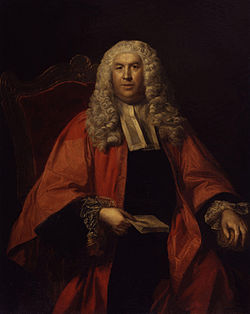
Every American lawyer of the founding generation — John Adams, Jefferson, Madison, Hamilton, and John Marshall among them — learned law from the same book: William BlackstoneSir William Blackstone (10 July 1723 – 14 February 1780) was an English jurist, justice, and Tory politician most noted for his Commentaries on the Laws of England, which became the best-known description of the doctrines of the English common law. Read more on Wikipedia ↗ (CC BY-SA)'s Commentaries on the Laws of England (1765–1769). Blackstone's achievement was to take centuries of scattered common-law precedent and render it as a coherent system, organized around a core claim: that certain rights — to personal security, personal liberty, and private property — were the "absolute rights of individuals," older than any charter and merely recognized, not created, by English law. Colonial lawyers absorbed that vocabulary of inherent rights wholesale, even as they turned it against the very Parliament Blackstone served: Blackstone himself was no revolutionary, and defended Parliament's sovereign, unlimited authority over the colonies, including its right to tax them. The Declaration's framers kept his rights-talk and discarded his conclusion — using Blackstone's own account of what an Englishman's rights were to argue that Parliament, in overriding them, had forfeited its claim to Americans' obedience.
Thomas Paine (1737–1809)
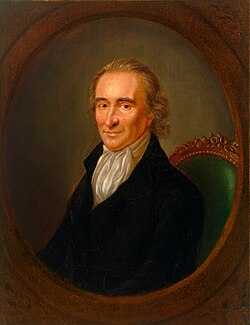
Everything above shaped the Declaration's ideas; Thomas PaineThomas Paine (born Thomas Pain; February 9, 1737 (O.S. January 29, 1736) – June 8, 1809) was an English-born American Founding Father, revolutionary, political theorist, philosopher, and author. He authored Common Sense (1776) and The American Crisis (1776–1783), two of the most influential pamphlets of the American Revolution. Read more on Wikipedia ↗ (CC BY-SA) is the reason there was a Declaration to write at all in July 1776 rather than years later. Published anonymously on January 10, 1776, his pamphlet Common Sense sold roughly 120,000 copies within three months, in a population of about 2.5 million free colonists, making it by far the best-selling work an American had yet produced. Where earlier grievances had been framed as a dispute with Parliament that a good king might still resolve, Paine attacked the monarchy itself, calling hereditary succession an absurdity and insisting there was no reason "the Almighty" would have singled out one family to rule over the rest of the human race forever. Jefferson received an early copy in February 1776 and began drafting the Declaration that June. Where the other figures on this page supplied the Declaration's philosophical vocabulary, Paine supplied the public appetite for using it: he turned an argument among educated men about the rights of Englishmen into a mass movement for a new nation.
Coda: The Federalist Papers and the Question of Human Nature (1787–1788)
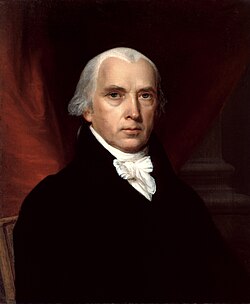
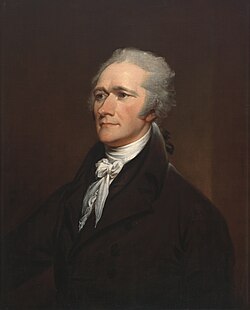
Everything above predates the Declaration; this one deliberately does not. The Declaration justified independence, but it took eleven more years to design the government that would carry its principles forward, and The Federalist PapersThe Federalist is a collection of 85 articles and essays written by Alexander Hamilton, James Madison, and John Jay under the collective pseudonym Publius to promote the ratification of the Constitution of the United States. Read more on Wikipedia ↗ (CC BY-SA) is the record of the argument for it — read the full text. It justified that government on a strikingly unsentimental view of the people who would run it. James MadisonJames Madison (March 16, 1751 [O.S. March 5, 1750] – June 28, 1836) was an American statesman, diplomat, and Founding Father who served as the fourth president of the United States from 1809 to 1817. Read more on Wikipedia ↗ (CC BY-SA) put it plainly in Federalist No. 51: "If men were angels, no government would be necessary. If angels were to govern men, neither external nor internal controls on government would be necessary. In framing a government which is to be administered by men over men, the great difficulty lies in this: you must first enable the government to control the governed; and in the next place oblige it to control itself." Alexander HamiltonAlexander Hamilton (January 11, 1755 or 1757 – July 12, 1804) was an American military officer, statesman, and Founding Father who served as the first U.S. secretary of the treasury from 1789 to 1795 under the presidency of George Washington. Read more on Wikipedia ↗ (CC BY-SA) made the same point in No. 15, asking why government exists at all: "Because the passions of men will not conform to the dictates of reason and justice without constraint." The Constitution's separation of powers, its checks and balances, its elaborate machinery for making ambition "counteract ambition" — all of it follows from the premise that no one, however well-intentioned, should be trusted with unchecked power, because no one is reliably good enough to deserve that trust.
That premise was not the only one on offer in the 1780s. In France, Jean-Jacques RousseauJean-Jacques Rousseau (28 June 1712 – 2 July 1778) was a Genevan philosopher, philosophe, writer, and composer. Read more on Wikipedia ↗ (CC BY-SA) had argued the opposite: that man is naturally good, and it is society and its institutions that corrupt him. The French Revolution, beginning just months after the U.S. Constitution's ratification, drew on that premise more directly — and its architects concluded that sweeping away corrupt institutions, rather than checking and dividing power, was the surer road to liberty. The Terror that followed it is the case historians of the American founding often cite against that wager^1, though France's revolution had its own distinct causes and the comparison is a historical argument, not a settled verdict. What the Federalist Papers show is a fact about the American design regardless of how that comparison is judged: Madison's and Hamilton's essays build the Constitution's checks and balances on the explicit premise that power will be abused if it is not divided — a premise some scholars trace to Reformation and Puritan ideas about a fallen human nature, and others trace simply to classical and Whig political theory's long distrust of concentrated power. Either way, the American and French revolutions both invoked the rights of man, but only the American one built its government on the assumption that whoever held power would, sooner or later, need to be checked rather than trusted.
Footnotes
[1] This argument is made by Barton Swaim, What the Founders Didn't TrustWall Street Journal, July 1, 2026See how these ideas landed in the founding documents themselves: read the Declaration, Jefferson's original rough draught, and the Constitution. Think a public reading belongs at your local Fourth of July event? Sign the petition.