
The American Revolution: A Historic Portal
1765–1783 — the acts, protests, debates, battles, and treaties that produced American independence
What this page is: a curated jumping-off point to primary-source texts of the American
Revolution — petitions, proclamations, treaties, letters, and speeches — hosted in full on
Wikisource, the free-content library of primary sources. It does not reproduce those texts here; it links
to them, organized chronologically and by topic, so a reader can go from "why did this happen" straight to
the document itself. For the Declaration of Independence specifically, see The
Declaration and Jefferson's Original Rough Draught on this site.
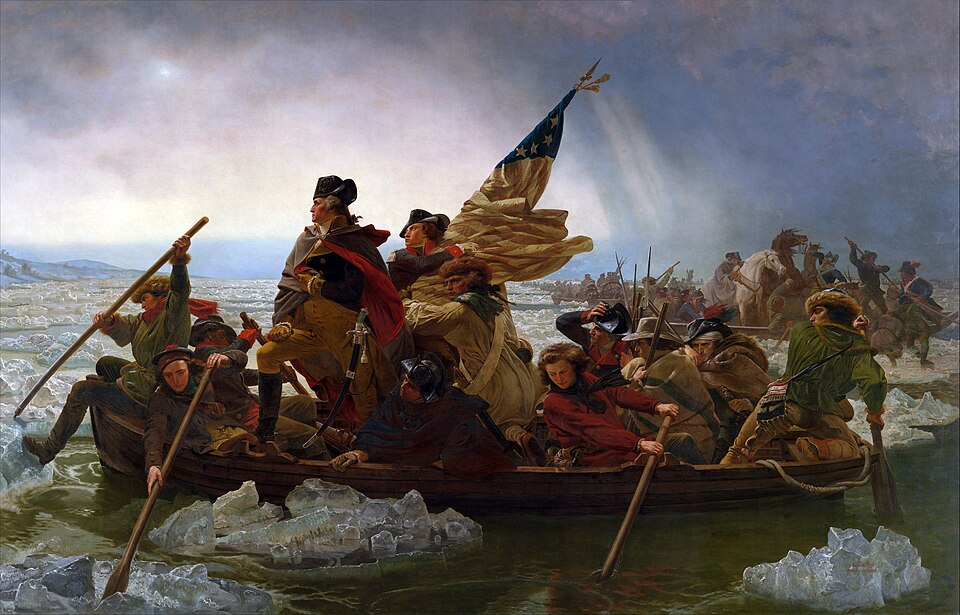
Road to Revolution, 1765–1768
- Stamp Act of 1765 — the first direct tax Parliament levied on the colonies, requiring stamped paper for legal documents, newspapers, and playing cards.
- Declaration of Rights and Grievances — adopted by the Stamp Act Congress, October 1765, asserting "no taxation without representation."
- Virginia Resolutions Against the Stamp Act — Patrick Henry's resolutions before the House of Burgesses, May 29, 1765.
- Declaratory Act — passed alongside the Stamp Act's repeal in 1766, asserting Parliament's authority to legislate for the colonies "in all cases whatsoever."
- Townshend Acts — new duties on glass, lead, paint, paper, and tea, 1767–1768, that reignited colonial resistance after the Stamp Act's repeal.
- Letters from a Farmer in Pennsylvania — John Dickinson's widely reprinted essays arguing against the Townshend Acts.
- Massachusetts Circular Letter — the Massachusetts House's 1768 appeal to the other colonies to coordinate opposition to the Townshend duties.
Crisis in Boston
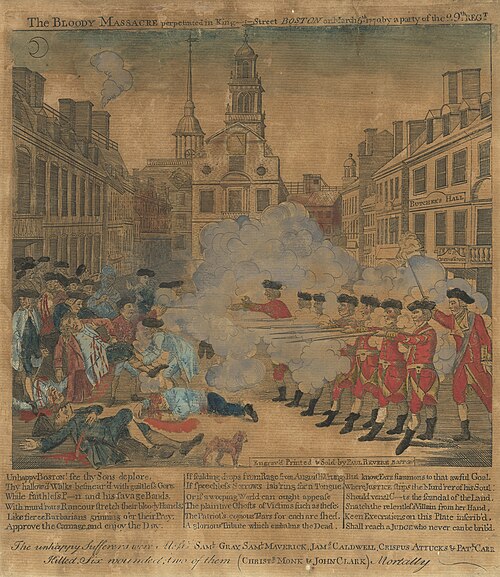
- A Journal of Occurrences — a running 1768–1770 chronicle of friction between Boston's residents and the British troops garrisoned among them.
- Boston Massacre accounts — competing narratives of the March 5, 1770 shooting, including those of James Bowdoin, Thomas Hutchinson, and John Adams (who defended the soldiers at trial).
- Tea Act of 1773 — granted the East India Company a tax-advantaged monopoly on tea sold in the colonies, provoking the Boston Tea Party.
- Philadelphia and Boston resolves — town resolutions of October–November 1773 rejecting the taxed tea shipments; part of the wider protest wave documented on Wikisource's American Revolution portal.
- Edenton Resolves — October 25, 1774; North Carolina women publicly pledged to boycott British tea and cloth, an early instance of organized political action by American women.
The Intolerable Acts and the First Continental Congress
- Boston Port Act, Massachusetts Government Act, Quartering Act of 1774, and the Quebec Act — the four "Intolerable Acts" of 1774, meant to punish Massachusetts and isolate it, which instead united the colonies against Parliament.
- Suffolk Resolves (Massachusetts, September 1774) and Fairfax Resolves (Virginia, July 1774) — county-level resolutions, endorsed by the Continental Congress, that rejected the Intolerable Acts and organized colonial resistance.
- Declaration and Resolves of the First Continental Congress, October 1774 — the colonies' first joint statement of rights and grievances against Parliament.
- The Continental Association — the coordinated colony-wide boycott of British goods adopted by the First Continental Congress.
- Petition to the King — the First Continental Congress's appeal directly to George III, October 1774, still hoping for reconciliation.
War Begins
- "Give Me Liberty, or Give Me Death!" — Patrick Henry's speech to the Second Virginia Convention, March 23, 1775.
- Battle of Bunker Hill accounts — June 17, 1775; a costly tactical British victory that showed colonial militia could stand against regular troops.
- Declaration of the Causes and Necessity of Taking Up Arms, July 6, 1775 — drafted in part by Thomas Jefferson and John Dickinson, justifying armed resistance while still professing loyalty to the Crown.
- Olive Branch Petition, July 8, 1775 — Congress's last formal appeal to George III to prevent further war; the King refused to receive it.
- Proclamation for Suppressing Rebellion and Sedition, August 23, 1775 — George III's declaration that the colonies were in open rebellion.
- Dunmore's Proclamation, November 1775 — Virginia's royal governor offered freedom to enslaved people who fled their rebel masters to fight for the Crown.
Independence and the New Nation
- Lee Resolution, June 1, 1776 — Richard Henry Lee's motion in Congress "That these United Colonies are, and of right ought to be, free and independent States," which set the Declaration in motion.
- The Declaration of Independence, adopted July 4, 1776 — read it on this site, alongside Jefferson's original rough draught and what the Continental Congress changed before adoption.
- Articles of Confederation — the first American constitution, drafted 1777, ratified 1781.
- The American Crisis, Thomas Paine, December 19, 1776 — "These are the times that try men's souls," read to Washington's troops before the crossing of the Delaware.
- National Thanksgiving Proclamation, 1777 — Congress's proclamation marking the victory at Saratoga, the first Continental Congress-wide day of thanksgiving.
International Alliances
- Franco-American Treaty of Alliance and Treaty of Amity and Commerce, February 6, 1778 — France's formal military alliance with the United States, decisive to the war's outcome.
- Treaty of Aranjuez, April 12, 1779 — brought Spain into the war against Britain, though not as a formal ally of the United States.
- Declaration of Armed Neutrality, Catherine II of Russia, March 1780 — organized neutral maritime powers against British naval blockades, further isolating Britain.
- Treaty of Paris, September 3, 1783 — negotiated by Benjamin Franklin, John Adams, and John Jay, formally ended the war and recognized American independence.
Voices of the Revolution: Letters, Memoirs & Literature
- The Adventures of a Revolutionary Soldier — Joseph Plumb Martin's memoir of the war in the ranks, among the fullest surviving accounts by an ordinary Continental soldier.
- Familiar Letters of John and Abigail Adams During the Revolution — including Abigail's 1776 charge to "remember the ladies" in any new code of laws.
- The Sentiments of an American Woman, Esther De Berdt Reed, 1780 — a broadside launching a women-organized fundraising campaign for Continental soldiers.
- Concord Hymn, Ralph Waldo Emerson — source of the phrase "the shot heard round the world."
- Paul Revere's Ride, Henry Wadsworth Longfellow, 1861 — the poem that made Revere's midnight ride a national legend, written on the eve of the Civil War.
- The Partisan, William Gilmore Simms, 1835 — a novel of the Revolutionary War in South Carolina.
Historical Analysis
- History of the Rise, Progress, and Termination of the American Revolution, Mercy Otis Warren, 1805 — one of the first histories of the Revolution, written by a participant and correspondent of its leading figures.
- "The American Revolution", Lord Acton, 1906 — a lecture on the Revolution's place in the history of political liberty.
- "Sovereignty in the American Revolution", Claude H. Van Tyne, 1907 — an essay on how the colonists' legal theory of sovereignty shifted over the course of the conflict.
- Timeline of the American Revolution, National Park Service, 2006 — a year-by-year reference chronology.
Key Figures
American Leaders
- George Washington — commander of the Continental Army, later first President.
- Samuel Adams — Boston organizer of the Sons of Liberty and the committees of correspondence.
- John Adams — delegate to both Continental Congresses, diplomat, later second President.
- Benjamin Franklin — secured the French alliance and helped negotiate the Treaty of Paris.
- Thomas Jefferson — principal author of the Declaration of Independence; see his rough draught on this site.
- Alexander Hamilton — Washington's aide-de-camp, later architect of the federal financial system.
- Patrick Henry — Virginia orator and first post-independence governor of Virginia.
- Ethan Allen — led the Green Mountain Boys in the capture of Fort Ticonderoga.
- Nathanael Greene — commanded the Continental Army's Southern campaign.
- Richard Henry Lee — moved the resolution for independence in Congress.
British and Loyalist Figures
- King George III — monarch against whom the Declaration's grievances are addressed.
- Lord North — Prime Minister who oversaw Britain's conduct of the war.
- Charles Cornwallis — British general whose surrender at Yorktown ended major fighting.
- Henry Clinton and William Howe — successive British commanders-in-chief in North America.
- Thomas Hutchinson — the last civilian royal governor of Massachusetts, a prominent Loyalist.
French Allies
- Marquis de Lafayette — French volunteer who became one of Washington's most trusted generals.
- Comte de Rochambeau — commanded the French expeditionary force at Yorktown.
- Comte de Grasse — French admiral whose fleet cut off Cornwallis's escape by sea at Yorktown.
- Comte de Vergennes — French foreign minister who engineered the alliance with the United States.
Other Notable Figures
- Abigail Adams — John Adams's wife and correspondent, an early advocate for women's legal rights.
- Mercy Otis Warren — playwright, propagandist, and the Revolution's first major historian.
- Esther De Berdt Reed — organized the Ladies Association of Philadelphia to fund the Continental Army.
- Benedict Arnold — a capable Continental general before his 1780 defection to the British.
- Robert Morris — "Financier of the Revolution," who helped fund the Continental war effort.
Related Portals on Wikisource
Agree the Fourth of July should mean more than fireworks? Sign the petition asking your local Independence Day organizers to include a public reading of the Declaration. See also how to petition your local and state government directly.
This portal adapts the category structure and link selection of Wikisource's Portal:American Revolution (text available under CC BY-SA), reorganized and re-described for this site. The primary-source documents it links to are hosted on Wikisource, not reproduced here.