
A History of 4th July as Civic observance of Independence day
How Independence Day became a day for reading the Declaration aloud — and how Abraham Lincoln remade what it meant
A Ritual From the Start
Even before the ink on the Declaration was dry, John AdamsJohn Adams was an American statesman, attorney, diplomat, writer, and Founding Father who served as the second president of the United States from 1797 to 1801. Before his presidency, he was a leader of the American Revolution that achieved independence from Great Britain. Read more on Wikipedia ↗ (CC BY-SA) predicted — and prescribed — how Americans would mark the day. Writing to his wife AbigailAbigail Adams was the second first lady of the United States, as the wife of President John Adams, and mother of the sixth president, John Quincy Adams. She is sometimes considered a founder of the United States. Read more on Wikipedia ↗ (CC BY-SA) on July 3, 1776, the day after Congress voted for independence, Adams wrote that the anniversary "ought to be commemorated, as the Day of Deliverance by solemn Acts of Devotion to God Almighty," and "solemnized with Pomp and Parade, with Shews, Games, Sports, Guns, Bells, Bonfires and Illuminations from one End of this Continent to the other from this Time forward forever more." Adams picked July 2, the day Congress voted for independence, not July 4, the day it adopted the text Jefferson had drafted — and history settled that argument in Jefferson's favor within his own lifetime. Something more personal than a miscalculation may already have been in it.[1] Decades later, in an 1822 letter to Timothy Pickering, an old Adams was dismissive of the Declaration's originality, writing that "there is not an idea in it but what had been hackneyed in Congress for two years before" the document existed.[2] People tend to admit late in life what they'd rather not say as younger men, and rivalries are usually more acute when we're young; it wouldn't be surprising if some of that same feeling toward his "frenemy" Jefferson was already there in 1776, just not yet spoken. If so, it may help explain why the holiday we actually got looks more like Adams's prescription — pomp, parade, games, guns, bells, bonfires — than a reading of Jefferson's text. And since Adams deserves his share of credit, as one of the chief advocates behind the July 2nd vote for independence - perhaps America should put on the "pomp and parades .. and bonfires" on July 2nd, which would prepare us for the more sober reflection that the Declaration of the 4th calls us to. The earliest surviving account of an annual Fourth of July celebration, from Philadelphia in 1777, fits the pattern Adams wanted:
Yesterday the 4th of July, being the anniversary of the Independence of the United States of America, was celebrated in this city with demonstrations of joy and festivity. About noon all the armed ships and gallies in the river were drawn up before the city, dressed in the gayest manner, with the colors of the United States and streamers displayed. At one o'clock, the yards being properly manned, they began the celebration of the day by a discharge of thirteen cannon from each of the ships, and one from each of the thirteen gallies, in honor of the Thirteen United States… The evening was closed with the ringing of bells, and at night there was a grand exhibition of fireworks (which began and concluded with thirteen rockets) on the Commons, and the city was beautifully illuminated. Every thing was conducted with the greatest order and decorum, and the face of joy and gladness was universal. Thus may the 4th of July, that glorious and ever memorable day, be celebrated through America, by the sons of freedom, from age to age till time shall be no more.As far as this account goes, no public reading of the Declaration at all.
Read Adams's full letter to Abigail at the National Archives' Founders Online ↗. This account of the 1777 Philadelphia celebration was first printed in the Pennsylvania Evening Post, July 5, 1777, and reprinted two weeks later in the Virginia Gazette, July 18, 1777.[3] This page doesn't take a side on whether readings were common at other early Fourth of July events — that's a real question for historians of the period — only on what this one well-documented celebration did and didn't include.
Lincoln's Fourth of July
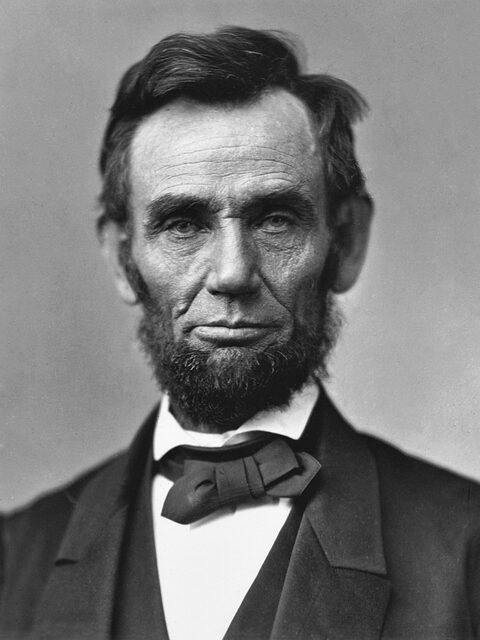
Few American leaders had a longer personal relationship with the holiday than Abraham LincolnAbraham Lincoln (February 12, 1809 – April 15, 1865) was the 16th president of the United States, serving from 1861 until his assassination in 1865. He led the United States through the American Civil War, defeating the Confederate States of America and playing a major role in the abolition of slavery. Read more on Wikipedia ↗ (CC BY-SA), according to historian Allen Guelzo. In 1839 he served as a Fourth of July parade marshal in Springfield, IllinoisSpringfield is the capital of the U.S. state of Illinois and the county seat of Sangamon County. Abraham Lincoln lived in Springfield from 1837 until 1861, when he left for Washington, D.C., to assume the presidency. Read more on Wikipedia ↗ (CC BY-SA), "in honor of Freedom's natal day," as one local paper put it. In 1845 he was scheduled to deliver the oration at Springfield's Fourth of July celebration, which began with a procession from the First Presbyterian Church and culminated in a public reading of the Declaration and a 28-gun salute; no text of his speech survives. In 1856 he devoted another Fourth of July address to "that Declaration made to the world, by our Fore Fathers, 'That all men are born free and equal.'" And when his eldest son, Robert Todd LincolnRobert Todd Lincoln was an American lawyer, businessman, and politician who served as the 35th United States Secretary of War from 1881 to 1885. He was the eldest son of President Abraham Lincoln and Mary Todd Lincoln, and the only one of the couple's four children to survive to adulthood. Read more on Wikipedia ↗ (CC BY-SA), was later invited to read the Declaration at a Fourth of July gathering, Lincoln's advice was characteristically direct: read it "every chance he has, and the bigger the crowd, the louder he must holler."
"Mere Rubbish, Old Wadding"
That affection curdled into something more complicated as the 1850s wore on. In May 1854, Congress passed the Kansas-Nebraska ActThe Kansas–Nebraska Act of 1854 was a territorial organic act that created the territories of Kansas and Nebraska. Drafted by Democratic Senator Stephen A. Douglas, its passage effectively repealed the Missouri Compromise of 1820 and reopened the question of slavery's expansion into the western territories, contributing to the violent sectional conflict remembered as "Bleeding Kansas." Read more on Wikipedia ↗ (CC BY-SA), opening the western territories to slavery and raising the prospect that new slave states would tip the balance of Congress itself. Speaking at Peoria that October, Lincoln called on the country to "re-adopt the Declaration of Independence, and with it, the practices, and policy which harmonize with it." Writing the following August to a Kentucky judge who defended slavery on constitutional grounds, Lincoln was blunter about what he thought had become of the document in practice: applied only to the men living in 1776, he wrote, it was "of no practical use now — mere rubbish — old wadding left to rot on the battlefield after the victory is won." The Fourth itself, he added in the same letter, "has not quite dwindled away; it is still a great day — for burning fire-crackers!!!" By 1858, running for Senate against Stephen Douglas, Lincoln sharpened the argument further: the nation's founders had restricted slavery's spread so that the public mind could rest in the belief that it was "in course of ultimate extinction." The holiday, for Lincoln, was never just a date on the calendar — it was a promissory note, and by the mid-1850s he thought the country was defaulting on it.
Read the full text of the Kansas-Nebraska Act at the National Archives ↗, Lincoln's Peoria speech ↗, his letter to George Robertson ↗, and the "House Divided" speech ↗.
The Special Session
The election of 1860, Southern secession, and the attack on Fort SumterFort Sumter is a sea fort built on an artificial island protecting Charleston, South Carolina from naval invasion. The Battle of Fort Sumter, in which the first shots of the American Civil War were fired, began on April 12, 1861. Read more on Wikipedia ↗ (CC BY-SA) in April 1861 changed the terms of that argument. When Lincoln summoned Congress into emergency session to respond to the crisis, he chose to convene it on July 4, 1861 — a date he did not pick by accident, given that the Confederacy he was asking Congress to confront represented, in his words, a direct repudiation of the very principle the day existed to mark. His message to that special session framed the war as a test of "whether a constitutional republic, or democracy — a government of the people by the same people — can or cannot maintain its territorial integrity against its own domestic foes."
Read the full message at Teaching American History ↗.
Gettysburg and Vicksburg
Two years later, on July 3 and July 4, 1863, Union victories at GettysburgThe Battle of Gettysburg was fought July 1–3, 1863, in and around the town of Gettysburg, Pennsylvania, by Union and Confederate forces during the American Civil War. It involved the largest number of casualties of the entire war and is often described as the war's turning point. Read more on Wikipedia ↗ (CC BY-SA) and VicksburgThe Siege of Vicksburg was the final major military action in the Vicksburg campaign of the American Civil War. Union Maj. Gen. Ulysses S. Grant's Army of the Tennessee besieged the Confederate river fortress city and forced its surrender, splitting the Confederacy and giving the Union control of the Mississippi River. Read more on Wikipedia ↗ (CC BY-SA) arrived clustered around the anniversary Lincoln had spent his whole public life measuring himself against. Addressing a crowd that marched to the White House on July 7, he could not resist the coincidence: "How long ago is it — eighty odd years — since on the Fourth of July for the first time in the history of the world a nation by its representatives, assembled and declared as a self-evident truth that 'all men are created equal.'" He went further, tying the moment to another July 4th coincidence: Jefferson and Adams had both died on the holiday's fiftieth anniversary in 1826, exactly, as Lincoln put it, when "it pleased Almighty God to take both from the stage of action." A rebellion built on overthrowing the Declaration's principle, meeting its two worst defeats on that principle's own anniversary, fit the same pattern he saw running through the holiday's history.
Read Lincoln's full remarks at Abraham Lincoln Online ↗.
Four Score and Seven Years Ago
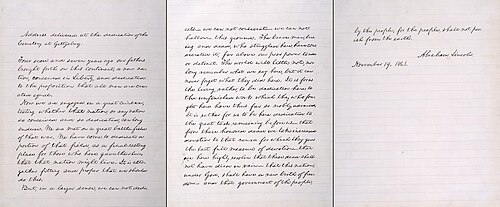
The July 7 remarks were improvised and unpolished; four months later, at the dedication of the national cemetery for the Union dead at Gettysburg, Lincoln returned to the same arithmetic and this time found the words that lasted, in the Gettysburg Address: "Four score and seven years ago, our fathers brought forth on this continent, a new nation, conceived in Liberty, and dedicated to the proposition that all men are created equal." From that address forward, the argument was settled in the American mind the way it had never quite been settled in 1776 itself: the nation's origin was not a matter of common ancestry, religion, or ethnicity, but of assent to a creed — the creed the Declaration had stated as self-evident, and the one Lincoln insisted the war was being fought to redeem. The edits Congress made to Jefferson's own draft show that creed was contested even as it was written; Lincoln's Fourth of July gave it its most enduring defense.
Two Presidents Who Understood
Of the presidents who came after the founders, Lincoln and Calvin CoolidgeCalvin Coolidge (born John Calvin Coolidge Jr.; July 4, 1872 – January 5, 1933) was the 30th president of the United States, serving from 1923 to 1929. Read more on Wikipedia ↗ (CC BY-SA) — born, fittingly, on the Fourth of July itself — are the two most often credited with treating the Declaration's claims as a standing debt rather than a period piece. Lincoln's case runs through this whole page: he read "all men are created equal" as an obligation still owed, not a fact settled once in 1776, and made ending slavery the price of paying it. Frederick DouglassFrederick Douglass was an American social reformer, abolitionist, orator, writer, and statesman. He was "the most important leader of the movement for African-American civil rights in the 19th century". Read more on Wikipedia ↗ (CC BY-SA), who had used his own 1852 Fourth of July address to indict the holiday's hypocrisy while slavery still stood — read the full account on the Juneteenth page — came in time to a similar reckoning with Lincoln himself. Speaking in 1876 at the unveiling of Washington's Freedmen's Monument, Douglass did not soften his verdict that Lincoln had been "preeminently the white man's President" — but weighing Lincoln's actions in full, he told the crowd, "we came to the conclusion that the hour and the man of our redemption had somehow met in the person of Abraham Lincoln."[4]
Fifty years after Gettysburg, at the Sesquicentennial in Philadelphia on July 5, 1926, Coolidge made a related argument from the opposite direction: not that the Declaration's principles needed updating for a new age, but that they were fixed points no later age was entitled to revise.[5] "If all men are created equal, that is final. If they are endowed with inalienable rights, that is final. If governments derive their just powers from the consent of the governed, that is final. No advance, no progress can be made beyond these propositions. If anyone wishes to deny their truth or their soundness, the only direction in which he can proceed historically is not forward, but backward toward the time when there was no equality, no rights of the individual, no rule of the people."
Notes
- This is not settled history, but a novel thesis of my own — Jared Essig, founder of this project. I haven't encountered another historian who has made this argument. ↩
- John Adams to Timothy Pickering, August 6, 1822. Teaching American History ↗ ↩
- "Yesterday the 4th of July…," Pennsylvania Evening Post, July 5, 1777; reprinted in the Virginia Gazette, July 18, 1777. Quoted in "How Americans Celebrated Independence Day in 1777," Mental Floss ↗; see also George Washington's Mount Vernon ↗. ↩
- Frederick Douglass, "Oration in Memory of Abraham Lincoln" (Freedmen's Monument unveiling), Washington, D.C., April 14, 1876. Teaching American History ↗ ↩
- Calvin Coolidge, "Address at the Celebration of the 150th Anniversary of the Declaration of Independence," Philadelphia, July 5, 1926. The American Presidency Project ↗ ↩
Sources for this page draw on Allen Guelzo, "Abraham Lincoln Remade the Fourth of July," Wall Street Journal, July 2, 2026, and on Lincoln's own letters and speeches. Read the Declaration itself, or the tradition of ideas it drew on. Think a public reading belongs at your local Fourth of July event? Sign the petition.