
Constitution Day
September 17 — commemorating the signing of the U.S. Constitution at Independence Hall, Philadelphia, 1787
Read the Constitution
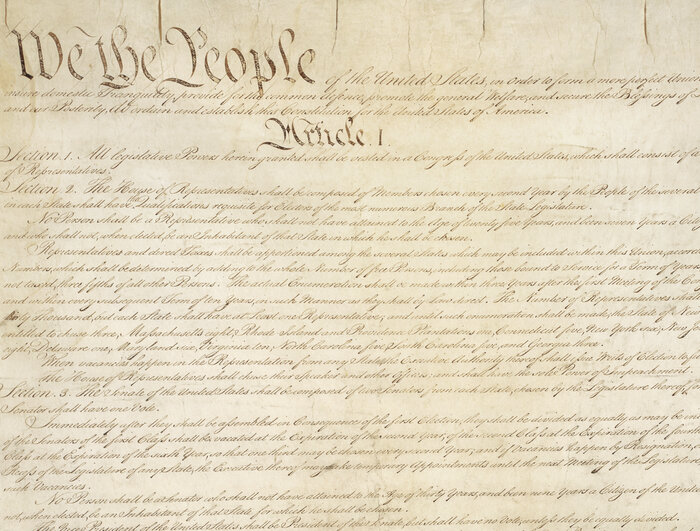
The Constitutional ConventionThe Constitutional Convention took place in Philadelphia from May 25 to September 17, 1787. While the convention was initially intended to revise the league of states and the first system of federal government under the Articles of Confederation, leading proponents of the Constitutional Convention, including James Madison of Virginia and Alexander Hamilton of New York, sought to create a new frame of government rather than revise the existing one. Read more on Wikipedia ↗ (CC BY-SA) finished its work and delegates signed the document on September 17, 1787, after four months of closed-door debate in Philadelphia. It replaced the failed Articles of Confederation with the government that has governed the United States, with amendments, ever since.
Read the annotated ConstitutionThe Constitution Annotated (formerly "The Constitution of the United States of America: Analysis and Interpretation," and known by scholars as CONAN) is a comprehensive treatise on constitutional law based entirely on the U.S. Constitution and its interpretation by the Supreme Court. Prepared by the Congressional Research Service, it explains, clause by clause, how courts have construed the Constitution's text over time. Read more on Wikipedia ↗ (CC BY-SA) on constitution.congress.gov ↗, which pairs the text with the Congressional Research Service's clause-by-clause analysis of how courts have interpreted it — or read the U.S. Constitution on Wikisource ↗Related Historical Documents
- The Bill of Rights — the first ten amendments, ratified 1791, guaranteeing the individual liberties the Constitution's critics said the original document lacked.
- The Articles of Confederation — the first American constitution (1781–1789), whose weaknesses made the Constitutional Convention necessary.
- The Federalist Papers — the 85 essays by Hamilton, Madison, and Jay arguing for ratification, still cited by courts today to interpret the Constitution's meaning.
- The Northwest Ordinance — passed by the Confederation Congress in 1787, it banned slavery in the Northwest Territory and set the pattern for admitting new states as equals, not colonies.
- Jefferson's Original Rough Draught — including what Congress changed before adopting the Declaration.
A Solemn Assembly, Not a Spectacle
Every Fourth of July, American towns hold parades, cookouts, concerts, and fireworks. Almost none of them hold a comparable celebration on September 17. We think the calendar has it backwards.
July 4, 1776 was not a victory. It was a declaration — a formal, public act of defiance, addressed "to a candid world," announcing that thirteen colonies now considered themselves at war and independent, and staking "our lives, our fortunes, and our sacred honor" on the outcome. The war had already been underway for over a year, since Lexington and ConcordThe Battles of Lexington and Concord on April 19, 1775, were the first major military actions between the British Army and Patriot militias from British America's Thirteen Colonies during the American Revolutionary War. The opposing forces fought day-long running battles in Middlesex County in the Province of Massachusetts Bay, in the towns of Lexington, Concord, Lincoln, Menotomy, and Cambridge. Read more on Wikipedia ↗ (CC BY-SA) in April 1775, and it would grind on for six more years after the signing, through Valley ForgeValley Forge was the winter encampment of the Continental Army, under the command of George Washington, during the American Revolutionary War. The Valley Forge encampment lasted six months, from December 19, 1777, to June 19, 1778. Read more on Wikipedia ↗ (CC BY-SA), through defeats at New York and Charleston, through the winters that killed as many soldiers as combat did, until CornwallisGeneral Charles Cornwallis, 1st Marquess Cornwallis was a British Army officer, Whig politician and colonial administrator. In the United States and United Kingdom, he is best known as one of the leading British general officers in the American War of Independence. His surrender in 1781 to a combined Franco-American force at the siege of Yorktown ended significant hostilities in North America. Read more on Wikipedia ↗ (CC BY-SA) surrendered at YorktownThe Siege of Yorktown, also known as the Battle of Yorktown and the surrender at Yorktown, took place in 1781 and was the final major land engagement of the American Revolutionary War. It was won decisively by the Continental Army, led by George Washington, with support from the Marquis de Lafayette and French Army troops, led by Comte de Rochambeau, and a French Navy force commanded by the Comte de Grasse, defeating the British Army commanded by British Lieutenant General Charles Cornwallis. Read more on Wikipedia ↗ (CC BY-SA) in October 1781 — and even then the Treaty of ParisThe Treaty of Paris, signed by representatives of King George III of Great Britain and representatives of the United States on September 3, 1783, officially ended the War of American Independence and recognized the Thirteen Colonies, which had been part of colonial British America, to be free, sovereign and independent unified states. Read more on Wikipedia ↗ (CC BY-SA) that made independence official didn't arrive until September 1783, seven years after the Declaration. Anyone reading the Declaration honestly on the day it was signed would have had no idea whether the nation it announced would survive to see another July.
That is not an occasion for fireworks. It is an occasion for a solemn assembly — a reading of what was pledged, a reckoning with what it cost, and a remembering of who did not live to see it fulfilled. A nation that only knows the Declaration as a backdrop for a barbecue does not know what its founders actually risked when they signed it.
September 17, 1787 is a different kind of anniversary. It marks something that actually succeeded: a group of rival states, having already won their independence at enormous cost, sat in a room for four months and built a durable government by negotiation and compromise rather than by force — and that government, with amendment, is still governing the country almost 240 years later. If any date deserves parades, concerts, and fireworks, it is the one that marks a plan that actually worked, not the one that marks a wager whose outcome was still very much in doubt.
Put the two dates in their proper places: let the Fourth of July be observed the way a nation observes a costly promise not yet redeemed — with a public reading of the Declaration, as the poem on this site calls for, and with sober reflection on the war and the compromises on slavery embedded in that founding moment. And let Constitution Day, September 17, be the day of civic celebration — because it commemorates a government that was actually built, and that has actually lasted.
Agree? Sign the petition asking your local Fourth of July organizers to include a public reading of the Declaration — and consider raising the idea of a Constitution Day civic celebration with them too. See also how to petition your local and state government directly.